I Wore An Apple Watch, Oura, Whoop, And Fitbit Air All At The Same Time But Did Not Expect This..
Jun 16, 2026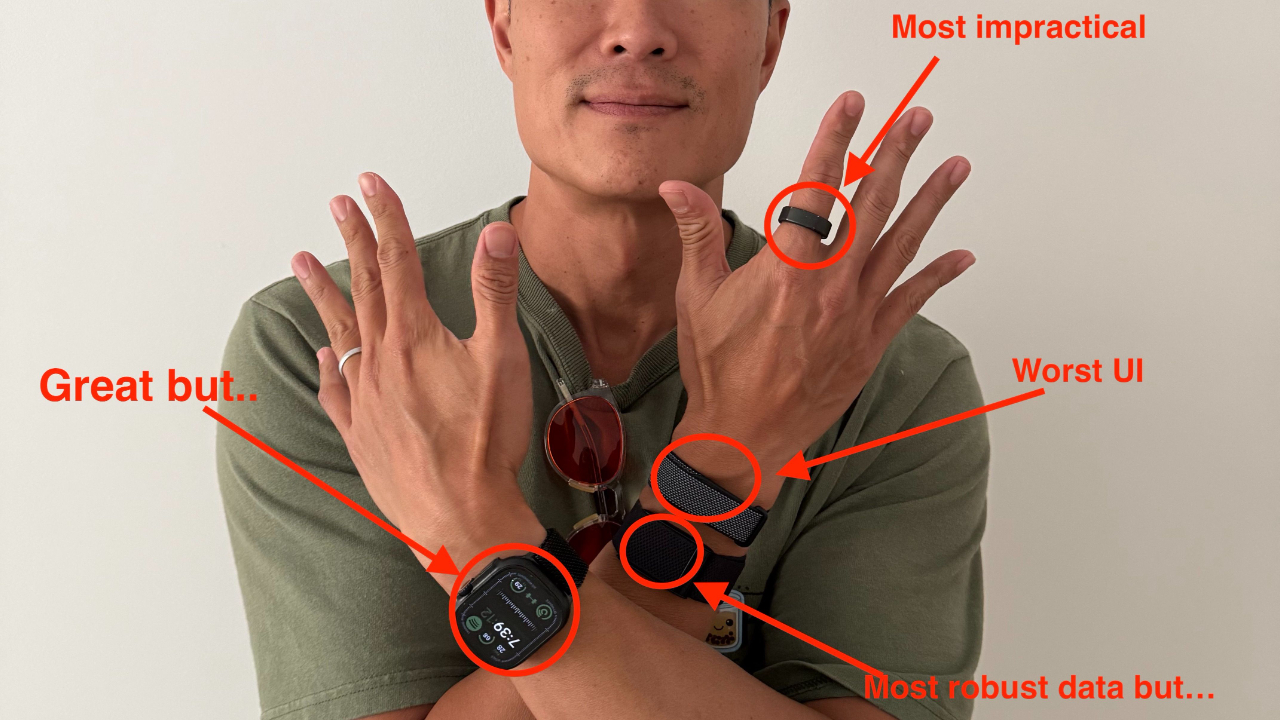
The High Performance Journal Written By Dan Go - June 16th, 2026
For a full week, I strapped 4 of the most popular health trackers onto my body at the same time: The Apple Watch, Oura, Whoop, and the new Fitbit Air from Google.
I assumed they would more or less agree, then I'd tell you which one I recommend, and we'd all move on with our lives.
That's not what happened.
One morning, one of them told me I got 81 minutes of deep sleep, while two others said I had 47.
This gap is part of the story. But to understand why it matters, I have to tell you something first, and if you want to skip over that, you can just scroll down to my observations.
I used to obsess about this stuff
For years I wore an Oura ring almost every night, and it genuinely changed my life.
Sleep is the #1 biomarker you have for health. The great thing about it is what you do during the day shows up in your sleep at night.
Tracking taught me what wrecked my sleep and what fixed it, and dialing that in was one of the best health decisions I've ever made.
What nobody tells you about having the data
After a few years, I knew my trends. I knew what good looked like for me and what bad looked like.
And that's when the data started doing something strange.
I'd wake up feeling incredible, ready to run through a wall, and then I'd check my recovery score, and it would say 67. Suddenly I'd feel a little worse than I did ten seconds earlier.
The number was now arguing with my own body, and the number was winning.
This is the part the wearable companies don't put on the box. Once you already know your trends, a constant stream of daily data stops informing you and starts overriding you. You feel great until a screen tells you that you shouldn't.
And that's before we even get to the fact that these things aren't all that accurate to begin with.
The accident that proved it
This January, I was surfing in Asia, and my Apple Watch broke. Talked about it in this newsletter.
I'd worn some kind of tracker nearly every day for about 5 years. Now I had nothing, I was halfway around the world, and I didn't feel like buying a replacement just to keep the streak alive.
So I went without one, and my life actually got a little better.
I stopped outsourcing how I felt to a device on my wrist. I'd wake up and decide how I felt based on, you know, how I actually felt.
So I stayed wearable-free for the next 5 months, and I didn't miss it.
Why test all the Apple, Whoop, Oura, Fitbit Air at the same time?
The thing about me is I'm both a health nerd and a curious consumer.
I've run my own glycine experiment, my own creatine test, my own psyllium husk test, and many others.
I do this because I believe we are all unique and the fact that we actually know that much about the human body yet, and I'd rather find out for myself than take someone's word for it.
When the Fitbit Air dropped, I finally had my excuse to do the thing I'd always wanted to do: put the major wearables head to head and see which one actually gives you the best data.
Here's what a week of wearing all of them taught me...
Dan Go's Note: Nobody paid me to do this. I bought these myself. When I announced the test, Whoop reached out on X and offered to send me their newest model for free. I first said yes, but I after more thought I declined. Don't get me wrong. I love free stuff but didn't want that tilting the results. I'm optimizing for truth, and truth is always cheaper when you get the gear yourself.
Finding 1: They agree you slept. They argue about everything else.
Total sleep time? All 4 landed within about half an hour of each other. Cool.
Deep sleep is where it fell apart. The devices split into 2 camps:
- Apple and Oura both had me around 47 minutes a night.
- Fitbit and Whoop had me up at 70 and 81. That's a 76% spread on the exact number people stress about.
REM was less wild but no cleaner. Apple read highest, at around 2 hours a night. The other three bunched together near 95 to 100 minutes.
The device that was stingiest on deep sleep turned around and was the most generous on REM. The variance you get on these devices was surprising.
Truth is, without a sleep lab wired to my head, I can't tell you which camp is right. Nobody can.
The Wall Street Journal just ran this same test through a Stanford sleep lab, and Apple's sleep staging came closest to the lab truth, which suggests the high numbers are the flattering ones.
The big lesson: Trust your sleep duration and your trend. Ignore the stage-by-stage breakdown. And never, ever compare your deep sleep to a friend on a different device. You're comparing 2 guesses.
Finding 2: Can they match my pedometer?
I wanted to know which device actually counted my steps. So I wore a basic pedometer for a day as a reality check.
Apple and Fitbit came closest to the truth, tracking within a few hundred steps of the pedometer. Whoop consistently credited me with more steps than I actually took.
Oura is a different case. When I kept the ring on all day, it tracked similarly to Apple. The only reason its weekly totals came in low is that I take it off to lift and to swim, so it misses a chunk of steps by design.
Oura is a different case: I had to take the ring off a few times as it was too clunky for several activities, so it can't count what it isn't on for.
In general, I found the Oura to be the least practical to wear, as I had to take it off when lifting, swimming, and even washing the dishes. They are coming out with a thinner version of their ring, so maybe I'll test that when it comes out.
The big lesson: trust the device you actually keep on all day, and treat the exact number as a rough guide, not gospel. If a tracker pads your count or rides in your pocket half the time, it's flattering you, not informing you.
Finding 3: The metric I ignored all week
The recovery scores were the most interesting of all.
I watched 2 devices score the same body's recovery over the same week.
One swung wildly from "you're wrecked" to "you're a machine." The other barely moved and called me fine the whole time. They couldn't even agree on my resting heart rate, the single simplest thing they measure.
I didn't act on any of it. 20 years into coaching my own body and other people's, I've learned that wrist and finger HRV aren't accurate enough to drive decisions. The exception is getting HRV off a chest strap.
The only time I'll take a recovery score seriously is when it gives me an extreme reading like that one time it flagged my body temp as being too high, signalling an incoming sickness.
Otherwise, I ignore it and just tell myself that I feel great. Usually works out.
The big lesson: Take the daily recovery score with a grain of salt. Watch for extremes: a crashed score plus a climbing resting heart rate plus feeling off, and trust your trend for everything in between.
Living with them, and what they really cost
Apple has to be charged every single day, which is the one real knock against it.
The other 3 have fantastic battery life. The Fitbit Air is so thin and light I forgot I had it on. The Oura looks great, but it gets in the way at times. Whoop is fatter than the Fitbit Air but still great.
When it comes to app user experience, Whoop wins hands down. Oura is a close second, Apple Watch is third, and Google Health can use a bit of work.
Then there's the membership fee. Apple and the Fitbit Air give you your data with no membership.
Oura makes you pay a subscription, but Whoop...
Whoop runs on a membership too, which would be fine, except I had to spend 10 minutes to figure out how to cancel it.
You can't do it on the app, meaning you gotta hunt for the desktop site. Then you still can't cancel until you sit through a 5-minute exit survey. Am I being a boomer by wanting to click a button to cancel whenever I want? I'll let you draw your own conclusion about that.
So which one should you buy?
It depends on who you are.
Want one device that does everything in real time, and you can live with charging it nightly? Apple Watch.
Hate subscriptions and just want clean, honest basics? Fitbit Air or Apple.
Want good UX and a wider variety of health metrics to track that you'll happily pay for it? Whoop, but mind the hoops you have to jump through to cancel.
Want a ring, love the look, and don't care to wear it all the time? Oura.
The real lesson isn't about which tracker to buy
The test was great. I'm also genuinely glad it's over. Checking one wearable every morning isn't my idea of fun. Multiply that by 4, and you get the picture.
So I'm going back to wearing a dumb watch on my wrist whose only function is telling me the time.
The only time the Apple Watch goes back on is for a workout, because being able to track a session without dragging my phone along is one of the best things it does.
If I had to wear one tracker for the rest of my life, it would be the Apple Watch, purely because it's the most versatile.
I don't need the data to be perfect. I just need it to be directionally correct. Fix the battery, and it's the best one all-around health tracker.
But I've already worn it for years and already know my trends. And once you know yours, the daily number stops being information and starts being a habit you don't need.
Either way, I hope this article was helpful. The best wearable is the one that changes a decision. If it doesn't change your decisions, then it's okay to not wear it.
Onward and upward. 🚀
- Dan
When you're ready, here are 2 ways I can help:
1. The Lean Body 90 System: When you’re ready to get in great shape, Lean Body 90 is the obvious choice. You can get in great shape and reach your fitness goals in just 90 minutes a week. Lose weight and build muscle even without hours in the gym or highly restrictive diets. Join 1000+ students here.
2. Are you an entrepreneur who wants to get lean, boost energy, and get in your best shape? Apply for private one-on-one coaching here.
Disclaimer: This email is provided for educational and informational purposes only and does not constitute providing medical advice or professional services. The information provided should not be used for diagnosing or treating a health problem or disease, and those seeking personal medical advice should consult with a licensed physician.