I'm 46. Here's The Protocol I Used To Fix My Chronic Low Back Pain:
Jul 21, 2026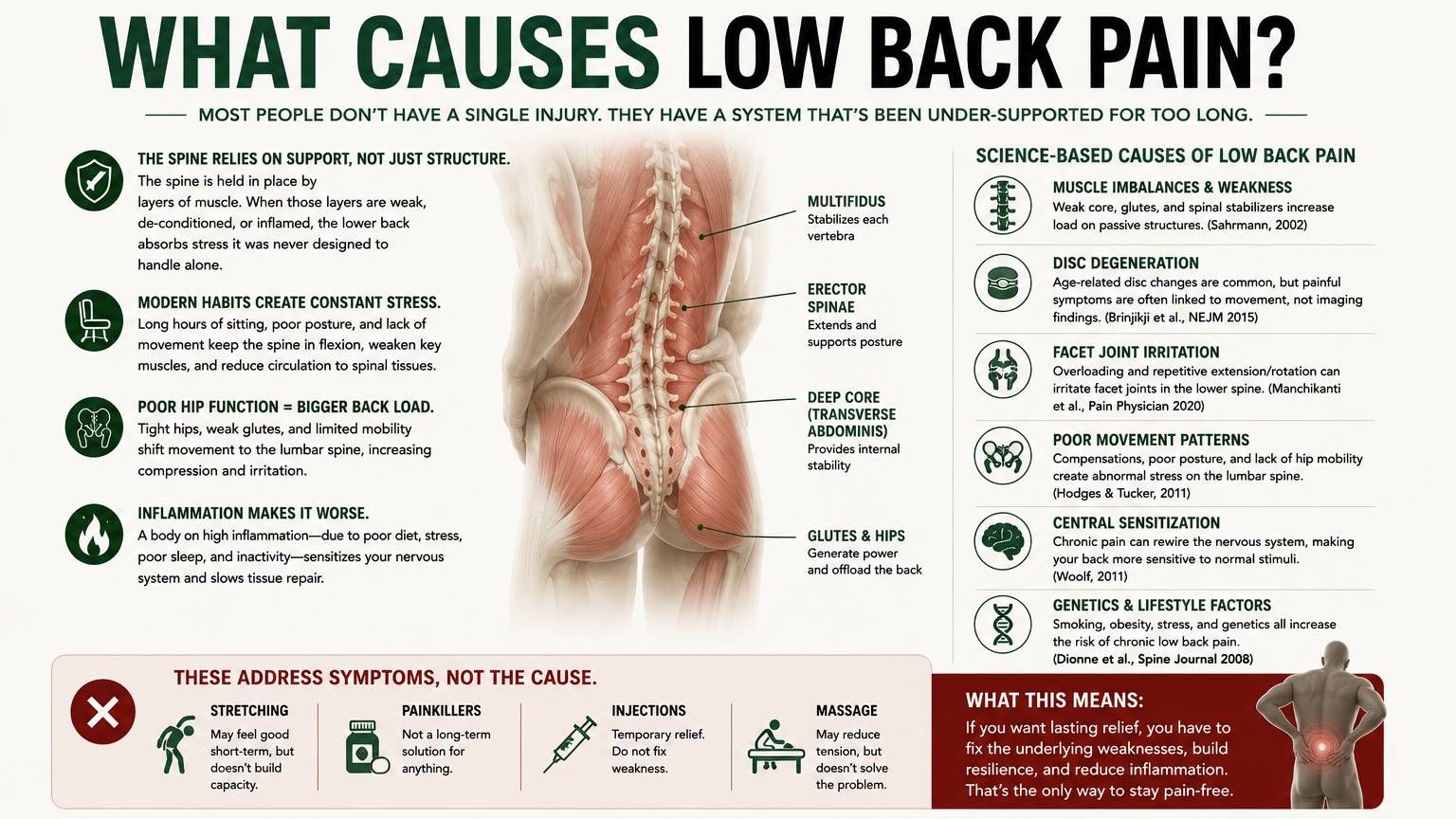
The High Performance Journal Written By Dan Go - July 21st, 2026
In my thirties, I moved like an 80-year-old who just had hip surgery.
Every morning, I'd wake up and quietly assess my back: How does it feel today? How can I get out of bed without pain?
Every time I got up from a chair, I had to do it slowly and carefully because the wrong angle would trigger pain up my spine. I dealt with all this for more than a decade, and I tried everything:
- Stretching
- Chiro appointments
- Painkillers
Nothing worked long term.
I remember sitting across from a chiropractor who had just adjusted me, and I was told that I would need to keep on coming back to him for the rest of my life just to manage the pain.
Each session was $75, and I had to do that for the rest of my life. I found that utterly ridiculous.
This forced me to go find my own answers, and what I eventually found out is that low back pain is not what most people think it is.
What Causes Low Back Pain?
Most people with chronic low back pain would find it surprising that they don't have a single injury. What they do have is a system that has been under-supported for quite some time.
The spine is held in place by layers of muscle. When those layers are weak, deconditioned, or inflamed, the lower back absorbs stress like it was never designed to handle alone.
Add in long hours of sitting at a desk, poor hip function, and a body on high inflammation, and you get a structure that feels like it's constantly under attack.
Stretching may make it feel better for a short period of time, but it won't fix it. Painkillers are not a long-term solution for anything. All these address the symptoms, and none of them address the underlying weaknesses.
What I found that works is a sequence. You build from the outside in, earning the right to load each layer before you move on to the next.
Before Building Anything, Stop What's Breaking You Down
For me, that meant basketball, intense circuits, and any workout done at high intensity. These were my primary forms of training at the time, and every time I went back to them, my back pain flared up.
There are certain activities you do that could trigger the pain. Our job when we're healing is to stay away from them.
This doesn't mean you give these things up forever. It means you take them off the table during the healing window so your body actually gets a chance to recover.
You can't rebuild a foundation while you're still cracking it.
The 2 Step Protocol I Used To Heal My Low Back Pain
Step 1: Indirect Strengthening First (Weeks 1 to 6)
What most people do is attack the low back first, but we don't want to do that. Your hip musculature is one of the biggest contributors to spinal stability.
When the glutes and hip extensors are weak, the low back compensates, so before you even touch the low back, you want to build a supporting foundation.
4 Exercises That Carry Most Of The Load Here:

The McGill Big 3. Bird dog, curl-up, and side plank. These train your spine to stabilize under controlled conditions without compression or loading.
The key while doing these exercises is to focus on bracing the core (pushing your abs out) and squeezing your glutes.
Hip Thrusts. The single best exercise for building glute strength that directly unloads the lumbar spine. Start with bodyweight, add load gradually as the pattern feels solid.
Step 2: Direct Low Back Strengthening (Weeks 5 Onwards)
Once the foundation is solid, you earn the right to train the low back directly.
Low Back Extension Holds. I started with low back extension holds (video courtesy of lowbackability). These are isometric holds, held for time. One to two sessions a week for the first two weeks.
The goal is teaching the erectors to fire and stay contracted without fatigue causing compensation.
The exercise that changed my life:
— Dan Go (@CoachDanGo) June 27, 2026
The low back extension.
I used to deal with chronic low back pain in my 20s and 30s.
Part of my protocol was using the McGill Big 3 (bird dog, McGill Crunch, side planks) to strengthen the supportive muscles around the low back.
I then used… pic.twitter.com/ASS5r97Eeh
Low Back Extensions. From there, I progressed to full extensions, starting with bodyweight only.
Loading came later, and only after I could perform clean, controlled reps without discomfort or shaking.
The progression matters as much as the exercise itself. I started with bodyweight only, then advanced to weights. Going too heavy too early is how most people re-injure themselves.
The key to doing the holds and the low back extension is to activate from the hip and glute and to avoid hyper-extension at the top.
The Foundation
While the protocol works, it works inside the right environment. We want to create an environment that keeps on working for you instead of fighting you.
Daily movement. Not structured training. Just walking, light mobility, getting the body out of the static positions that compress the spine for hours at a time. 20-30 minutes a day is enough.
Sleep. Most people don't connect their sleep to their pain levels. They should.
When you're sleep-deprived, your body's ability to regulate inflammation weakens. Pain tolerance decreases, and recovery slows. The same lower back that felt manageable after a solid eight hours becomes genuinely difficult after a few nights of poor sleep.
I started treating sleep as part of the treatment. Consistent sleep and wake times, a cool dark room, no screens in the hour before bed. Simple, but the compounding effect on how my back felt within 2 weeks was hard to ignore.
Nutrition. Chronic pain has a chemical component most people never address. When your body is inflamed, pain amplifies. The threshold for discomfort drops. What should be a signal becomes a constant alarm.
I pulled out the main offenders: ultra-processed foods, excess sugar, and alcohol.
And I added in the things that work against inflammation: omega-3s from fatty fish, colorful vegetables, adequate protein, enough water.
Mindset. This one gets skipped almost universally.
First, you must believe that you can be pain-free. The belief is the first step to overcoming anything.
Then there's ancient Hindu belief that lower back pain points to something modern medicine is slowly catching up to: unresolved emotional tension manifests physically.
John Sarno spent decades documenting this. Repressed emotion can create real, measurable pain.
For emotional pain, I found the best way out is through. A great book on this is Letting Go by David Hawkins and John Sarno's Healing Back Pain.
Last, I observed was having an identity of someone with low back pain. I felt the pain so often I didn't know what life would be like without it.
People who identify as "someone with a bad back" tend to stay that way. The identity reinforces the experience. The experience reinforces the identity.
Part of healing was changing how I talked about my back. One thing I kept telling myself was, "My back is healthy and getting stronger every day".
Words are powerful, and how you use them determines your reality. Make sure you're telling yourself the right things.
What Healing Actually Looks Like
The one thing I implore you to do is set a long time horizon for your healing. There will be good weeks, and there will also be setbacks. Setbacks don't mean you failed or that you're broken. It's a part of the journey.
The framework above took me several months to work through. And by the end of it, the morning inventory was gone. I still warm up before training. I still manage load thoughtfully. But I wake up free and without pain, and I wish for you the same.
If you're dealing with this, know that what you're experiencing is not permanent. It's a system problem, and system problems are solvable.
You just have to approach it in the right order.
Onward and upward. 🚀
- Dan
When you're ready, here are 2 ways I can help:
1. The Lean Body 90 System: When you’re ready to get in great shape, Lean Body 90 is the obvious choice. You can get in great shape and reach your fitness goals in just 90 minutes a week. Lose weight and build muscle even without hours in the gym or highly restrictive diets. Join 1000+ students here.
2. Are you an entrepreneur who wants to get lean, boost energy, and get in your best shape? Apply for private one-on-one coaching here.
Disclaimer: This email is provided for educational and informational purposes only and does not constitute providing medical advice or professional services. The information provided should not be used for diagnosing or treating a health problem or disease, and those seeking personal medical advice should consult with a licensed physician.