The Complete Guide To Reversing Insulin Resistance
Jul 07, 2026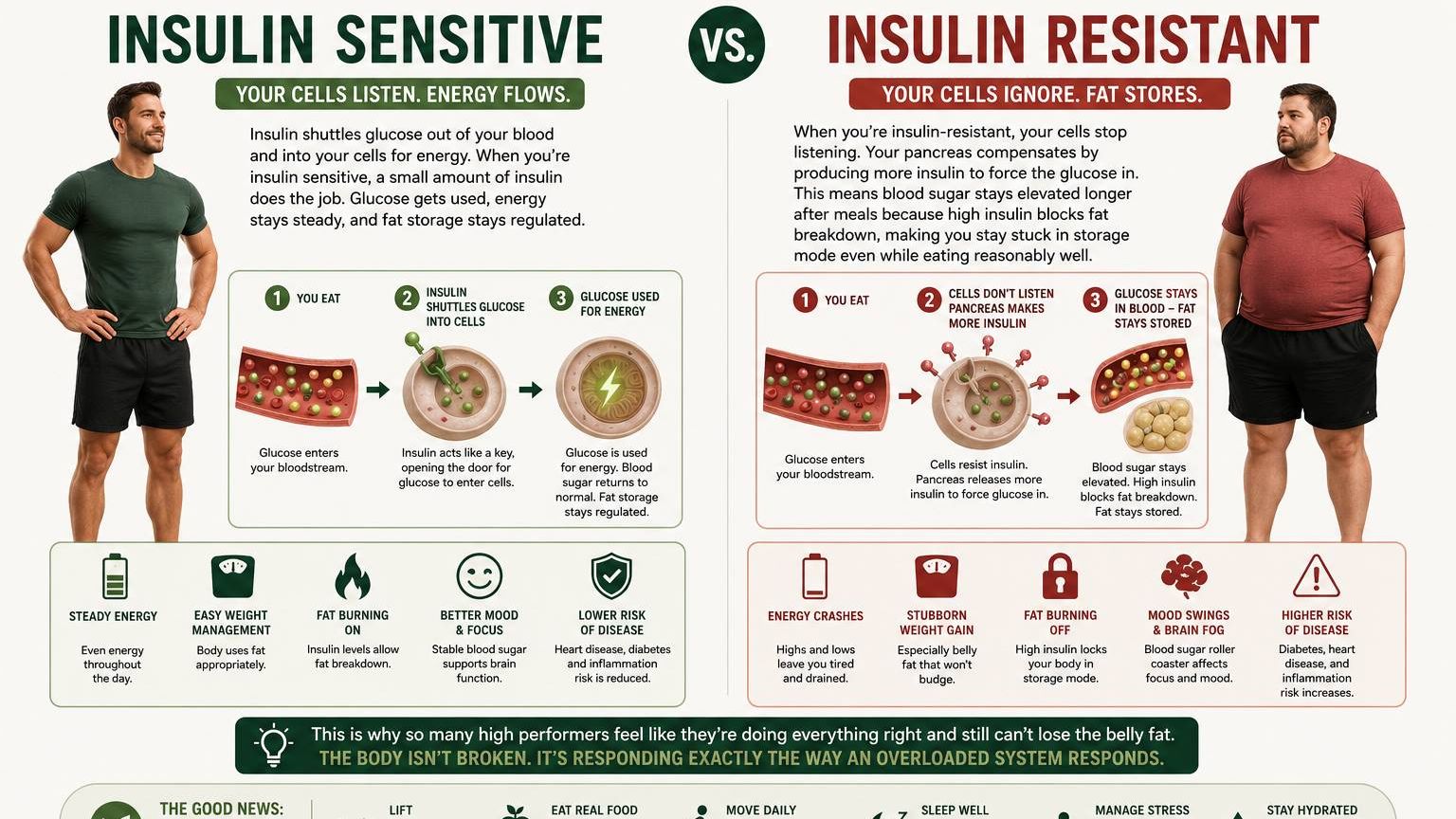
The High Performance Journal Written By Dan Go - July 7th, 2026
Only 12% of Americans are metabolically healthy. The other 88% have at least one marker that causes them to be insulin resistant.
Insulin resistance is not a middle-aged problem anymore. NHANES data on adults 18 to 44 found roughly four in ten are already insulin resistant, most of them having no idea.
Endocrinologists at Yale state that if you reverse insulin resistance, you also reverse type 2 diabetes, greatly reduce your risk of heart disease, fatty liver disease, and even certain types of cancers.
The great news is it's reversible. In today's newsletter, I want to share with you the protocol we use to help clients reverse insulin resistance in 120 days or less.
You ready? Let's go 🔥
What Is Insulin Resistance?
Insulin shuttles glucose out of your blood and into your cells for energy. When you're insulin sensitive, a small amount of insulin does the job. Glucose gets used, energy stays steady, and fat storage stays regulated.
When you're insulin-resistant, your cells stop listening. Your pancreas compensates by producing more insulin to force the glucose in. This means blood sugar stays elevated longer after meals because high insulin blocks fat breakdown, making you stay stuck in storage mode even while eating reasonably well.
This is why so many high performers feel like they're doing everything right and still can't lose the belly fat. The body isn't broken. It's responding exactly the way an overloaded system responds.
Symptoms of Insulin Resistance
- Afternoon brain fog
- Waking up tired after eight hours of sleep
- Getting hungry again shortly after a full meal
- Cravings that show up even when you're not hungry
- Skin tags or darkened patches at the neck or armpits
- Belly fat that won't move no matter how disciplined you are
- Energy crashes an hour or two after eating, especially carb-heavy meals
No Single Biomarker Tells The Whole Story
The number most people check for is fasting glucose to see if it's normal, but it's often the last thing to shift. By the time it's elevated, you've likely been insulin-resistant for years.
Insulin resistance shows up as a pattern across several markers before it shows up in any one of them:
- Fasting insulin, often the earliest signal
- HOMA-IR, a calculated ratio of the two above
- Triglyceride to HDL ratio, a useful low-cost proxy
- Fasting glucose and HbA1c, later-stage indicators
- Waist-to-height ratio, keep your waist under half your height
No single marker predicts insulin resistance. It's the combination that tells the whole story.
The 4 Pillar Protocol To Reversing Insulin Resistance
Sleep: Aim for 7 to 9 hours, consistently. One bad night measurably lowers insulin sensitivity the next day through stress hormones and appetite regulation. If you snore or feel excessively tired during the day, get sleep apnea checked, it's tightly linked to insulin resistance and often missed. Keep sleep and wake times consistent, and get morning light early.
Movement: Separate from your workout. Long stretches of sitting blunt glucose clearance even if you trained that morning. Get up for a few minutes every 30 to 60 minutes when you can. And walk for 10 to 15 minutes after meals, the single easiest lever on this list. Post-meal movement uses glucose directly through muscle contraction, no insulin required, and it blunts the spike from the meal you just ate.
Diet: Low-carb, not no-carb. Your body's ability to clear glucose is temporarily impaired, so the fix is reducing the load, not eliminating carbs. Favor fiber-rich, minimally processed foods, and pair carbs with protein and fat to blunt the spike. Keep your eating window aligned with your body clock: earlier breakfast, last meal 3 to 5 hours before bed. This is the same 90/10 approach I coach everywhere else: a lighter load while your body relearns how to respond to insulin, not a permanent restriction.
Exercise: Weights and walking are the foundation. Resistance training builds muscle, your body's biggest glucose sink, more places for glucose to go that aren't your fat cells. Aerobic training pulls glucose into muscle through a pathway that doesn't need insulin at all, working around the exact block you're dealing with. Sprinting or HIIT is optional, useful once the base is in place. Consistency beats intensity, ten minutes daily beats one heroic hour once a week.
The Lesser Known (Yet Effective) Levers To Reversing Insulin Resistance
Treating sleep apnea aggressively if you have it: Beyond a CPAP machine, weight loss and airway treatment can meaningfully improve insulin resistance on their own.
Managing your stress: Chronic stress keeps cortisol elevated, and elevated cortisol worsens insulin resistance directly. Protecting recovery time isn't soft, it's mechanistic.
Target visceral and liver fat specifically: Reducing alcohol and fructose intake moves these fat stores more than weight loss alone, and they're the deposits most tightly linked to insulin resistance.
Supplements to take: Magnesium glycinate to support stress resilience and insulin signaling, vitamin D from sun or supplements to optimize hormonal and metabolic health, and omega‑3s plus psyllium husk to reduce inflammation and improve glycemic control via increased fiber and slower glucose absorption.
How Garret Reversed Insulin Resistance In 120 Days
When we worked with Garrett, his first red flag was his waist-to-height ratio. It was above 0.5. When we checked his blood work, his fasting insulin, HbA1c, and HOMA-IR all pointed in the same direction.
He was already exercising, but it was the wrong type of exercise, so we shifted the balance towards lifting and walking, which actually drives glucose disposal.
We also changed his eating, which was erratic, and built a schedule around his circadian rhythm, with his last meal coming at least three hours before bed. His meals were built around foods that support his gut health.
Finally, we fixed his sleep from inconsistent nights to a quality 7-8 hours.
120 days later, in his words, this was one of the most transformational processes he's ever gone through.
What To Expect
Yale's research on this exact mechanism found meaningful shifts within 8-12 weeks under controlled conditions. In the real world, with a full life running around it, Garrett's 16-week days are a more realistic benchmark, and it worked.
Either way, this is not a race. You didn't get insulin resistant overnight, and you won't reverse it overnight either.
But the body that feels like it's working against you can become the body that works with you again.
Work on these four foundations, and above all else, focus on consistency. Do this for 120 days, and your future self will thank you.
Onward and upward. 🚀
- Dan
When you're ready, here are 2 ways I can help:
1. The Lean Body 90 System: When you’re ready to get in great shape, Lean Body 90 is the obvious choice. You can get in great shape and reach your fitness goals in just 90 minutes a week. Lose weight and build muscle even without hours in the gym or highly restrictive diets. Join 1000+ students here.
2. Are you an entrepreneur who wants to get lean, boost energy, and get in your best shape? Apply for private one-on-one coaching here.
Disclaimer: This email is provided for educational and informational purposes only and does not constitute providing medical advice or professional services. The information provided should not be used for diagnosing or treating a health problem or disease, and those seeking personal medical advice should consult with a licensed physician.