The Complete Guide To The Psychology Of Weight Loss
Jul 28, 2026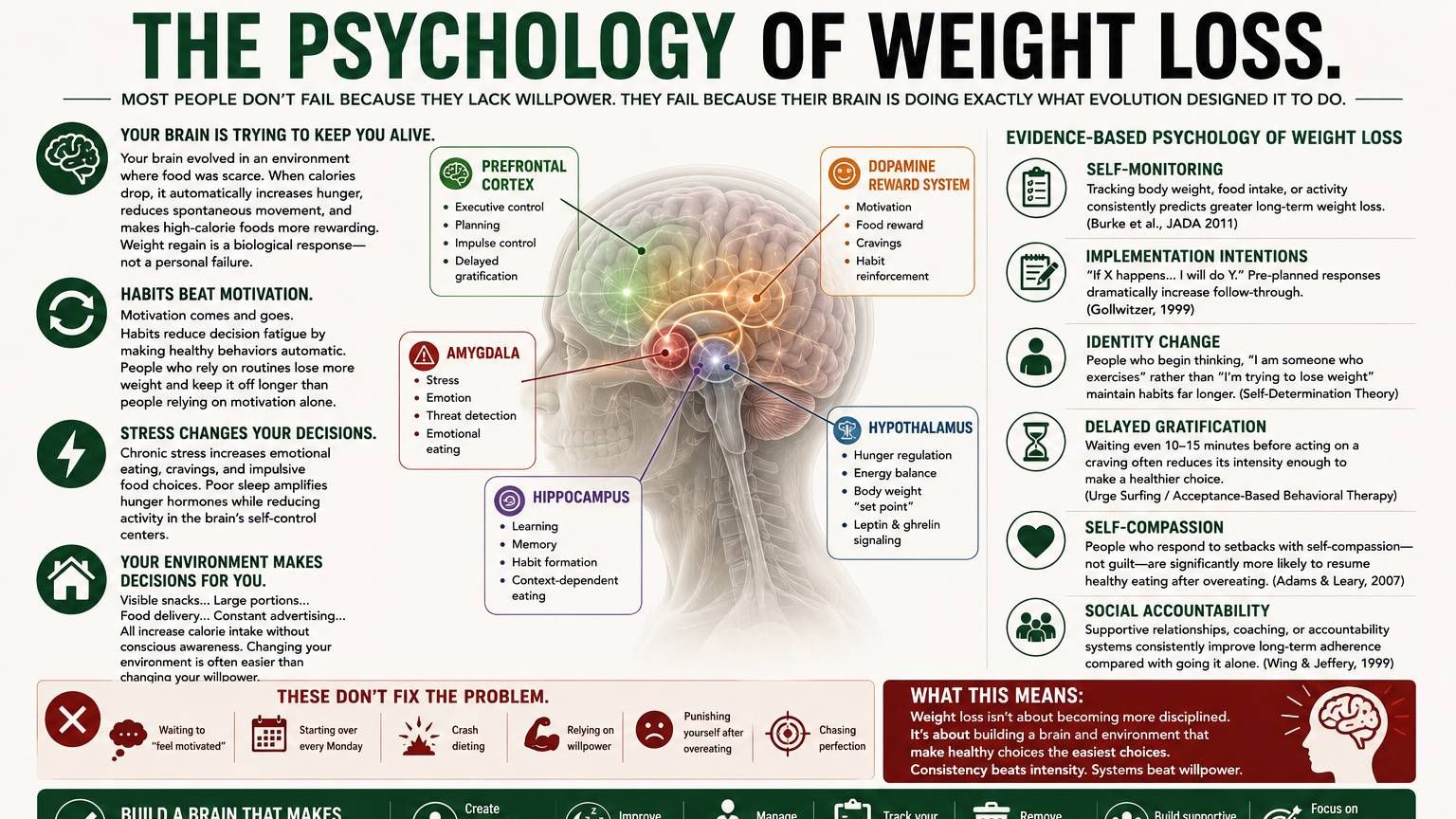
The High Performance Journal Written By Dan Go - July 28th, 2026
Please read this before continuing: I'm a health and performance coach, not a psychologist. If you're dealing with an eating disorder or serious mental health condition, please seek support from a qualified professional. What follows is for the person who's generally healthy but can't figure out why the weight won't stay off.
The single greatest skill that separates people who struggle with their weight from people who stay lean year-round isn't a better diet or a more disciplined training program.
It's mastering the psychology of weight loss.
In my 20s, I was 30 lbs overweight, directionless, and couldn't see a way out. I tried every program, every diet, every weight loss supplement, but nothing worked because I was trying to change my body without changing my mind.
I'm 46 now, in the best shape of my life, and I've spent the last decade helping high performers do the same. What I found coaching hundreds of people who were smart, driven, and still stuck with their bodies is that it was never a body problem. It was a psychology problem.
Specifically, there are 7 mental traps that keep people trapped in the same cycle.
If you want to get in shape and stay there, you need to understand what those patterns are and what to replace them with.
The 7 Hidden Mental Traps Causing Weight Gain
1) The internal script around weight loss and health
Most people don't realize they are running beliefs about health they've never examined. They tell themselves that they have bad genetics, or that they've always been this way, or that they don't have the discipline to get healthy. Or even worse: They secretly loathe fit people. These are conclusions formed from past attempts, influenced by others and years of failure. The first step is to write them down and put them up for scrutiny. You can't change a belief you haven't identified.
2) Too short a time horizon
When someone only gives themselves 6 weeks to lose weight, when it's taken them years to put it on, they do unsustainable things to get there. They never give themselves a chance to create the behaviors, identity, and habits needed to keep it up. When you extend the timeline, you'll find that the pressure drops and there's room to build habits rather than just trying to rush through a program.
3) All-or-nothing thinking/Aiming for perfection
The worst thing you could do is try to be perfect or adopt an "all or nothing" approach when it comes to your health. I dealt with this in my own life. I would be "off" with my diet, and it would cause me to think that I blew it and that the diet wasn't for me anyway. The pursuit of perfection is what derails most people, not a lack of effort. Also, research has found that all-or-nothing/perfectionism thinking significantly increases the likelihood of relapse.
4) Their environment
Most people trying to lose weight don't realize that they're sitting in a land mine of food temptation. The modern food environment has been engineered to work against you. Food companies spend billions designing hyper-palatable foods and ads to override your satiety signals. Most importantly, the people you spend the most time with shape your standards. it will be ten times harder to try to lose weight if you're not supported or you're around people who don't care about their health
5) Using food to manage emotion
Most people don't reach for food because they're hungry. They do it because they're stressed, anxious, bored, or overwhelmed. Food offers short-term relief from whatever feeling they don't want to sit with. The problem is the feeling comes back while bringing with it a healthy dose of shame. The shame triggers more eating, which creates more shame. You can't punish yourself to a healthy body.
6) Waiting to feel motivated
Motivation is a feeling, and feelings are unreliable. People who rely on routines lose more weight and keep it off longer than people who just do it when they feel ready. Discipline is what you use while motivation is absent. Routines are what make discipline unnecessary.
7) Trying to fix everything at once
Most people, when they decide to get serious, try to overhaul everything from their diet to their training to their sleep and stress all at the same time. This ends up burning them out within a few weeks, concluding that it wasn't meant for them. The smarter approach is to identify your one biggest bottleneck, the single thing that, if you fixed it, would make everything else easier, and start from there.
7 Evidence-Based Tools To Change Your Weight Loss Psychology
1) Self-monitoring
This means tracking what you eat, tracking how you feel, and tracking progress. A systematic review of 22 studies identified it as the centerpiece of successful behavioural weight loss programs. When I was trying to fix my weight loss issues, I kept a journal. One thing I found was that, through the process of tracking, you will gain awareness of mental patterns, and awareness is the first step to change.
2) Implementation intentions
This means to pre-plan our responses to high-risk situations. The simple format is: If X happens, I will do Y. An example of this will be: When I'm at the barbecue, and someone offers me a drink, I'll ask for a soda water with lime. Research by Gollwitzer showed this dramatically improves follow-through. Decisions made when you're calm hold when you're not.
3) Identity change
People who think "I am someone who trains" rather than "I'm trying to lose weight" sustain it far longer. Research on identity-based behavior change shows that behavior comes first and identity follows from repetition. In our coaching practice, we have a course called Identity Shifting, which takes people through the exact system I've used to change my mind, especially around my health. Because if there's one thing I know about transforming the body, it's that we must transform our identity to make it stick.
4) Urge surfing
Experts call this Urge Surfing, which is waiting 10 to 15 minutes before acting on a craving. It's a core mechanic in behavioral therapy, where you're not suppressing the urge but creating space between impulse and response. This has been something I've been beta-testing with my nutrition coaching app, and it's been incredible. One night I was having a date night with my wife, and I was thinking about having a second Old Fashioned. I ran it by my nutrition coaching app before I did that, and after asking me questions, I agreed to wait at least 15 minutes before making that decision. Once the 15 minutes passed, the craving was almost gone, and I decided to skip it. That's urge surfing in action.
5) Self-compassion
Shaming yourself after a lapse makes you more likely to keep going off track. Expressing self-compassion makes you more likely to course-correct. The next time you make a mistake, take a moment and observe what's going on in your thoughts. You might find that you are acting in less-than-compassionate ways that aren't adding to the solution. Instead, talk to yourself the way that you would support a best friend, especially after they've had a hard day.
6) Audit your environment
Make a list of everything in your physical and social environment that pulls you off course. I'm talking about things in your physical environment, whether it's in your office, your kitchen, or even your bedroom. I'm also talking about an audit of your network. Find people who exhibit healthy values and behaviors that you want to bring into your life, and hang around them more. The goal is to make your environment work for the person you're trying to become
7) Social accountability
Coaching, accountability partners, or supportive relationships consistently improve long-term adherence. You don't have to do this alone. In fact, the research suggests you probably shouldn't.
Build A Brain That Makes Healthy Choices Automatic
The goal isn't to lose weight, but to become someone who doesn't need to think about this problem ever again. We don't get there through hustling.
We don't get there through trying to rush the process.
We get there by solving one bottleneck at a time. It's an evolution, and like all evolutions, it doesn't happen over days or weeks. It can take years, and that's okay.
When you do this, you'll surprise yourself. Most people overestimate what they can change in six weeks and underestimate what they can change in two years.
The person you're capable of becoming is on the other side of evolving your mind.
Onward and upward. 🚀
- Dan
When you're ready, here are 2 ways I can help:
1. The Lean Body 90 System: When you’re ready to get in great shape, Lean Body 90 is the obvious choice. You can get in great shape and reach your fitness goals in just 90 minutes a week. Lose weight and build muscle even without hours in the gym or highly restrictive diets. Join 1000+ students here.
2. Are you an entrepreneur who wants to get lean, boost energy, and get in your best shape? Apply for private one-on-one coaching here.
Disclaimer: This email is provided for educational and informational purposes only and does not constitute providing medical advice or professional services. The information provided should not be used for diagnosing or treating a health problem or disease, and those seeking personal medical advice should consult with a licensed physician.