I'm 46. I Track These Health Metrics Religiously To Feel Like I'm 26.
Oct 20, 2026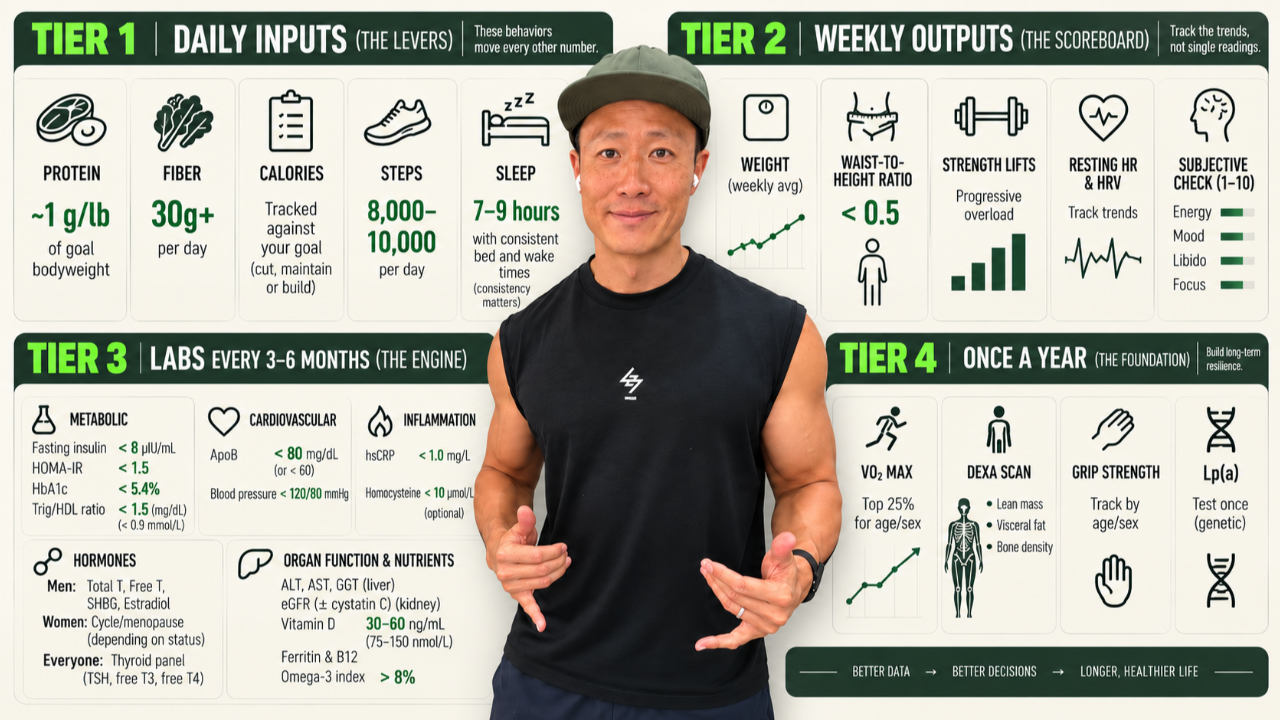
The High Performance Journal Written By Dan Go - October 20th, 2026
In last week's newsletter, I told you one of the biggest mistakes I made with longevity was chasing numbers.
A few of you replied with a fair question:
"Are there any numbers that my clients or I track to perform at their best?"
Well, yes, there are.
Just because I don't chase numbers doesn't mean I throw the baby out with the bathwater and claim that numbers aren't important.
Knowing your numbers means you know where you stand, so you know what to improve upon.
I'm about to turn 47 in November, and I'm feeling way better than I did in my 20s. The big reason is that I know my numbers.
In this newsletter, I want to share with you the numbers that I track, and a good number of them are ones that your doctor probably isn't testing for.
I break my numbers into 4 tiers based on how often they're worth looking at:
Tier 1 is Daily Inputs
Tier 2 is Weekly Outputs
Tier 3 is 6-month Labs
Tier 4 is Yearly Tests
Tier 1: Daily Inputs
These are the behaviors I do every day. Inputs are the only part I control, so this is where most of my attention goes.
Protein. I aim for a floor of about 0.7 g per lb of body weight and a ceiling of 1 g per lb. Protein is essential for healthy aging, and it's still the first thing I'd fix for most people.
This is the one I most often come up short on, so I track it daily. That's a big reason why I built HeySherpa, a nutrition coach I trained myself. It tracks your food in the background and coaches you toward your goals. It's been an incredible tool helping me get to 12% body fat. It's not out yet, but it's releasing in November. You can join the waitlist here.
Fiber. I aim for 25 to 35 g a day using vegetables and fruits, and if I come up short, then I'm going to use psyllium husk as my fiber insurance.
Calories and food quality. I’ve always tracked my food, but I never liked using calorie trackers. So, again, I used the app I built, HeySherpa. I just tell it what I ate or snap a photo, and it logs everything for me. It’s the first time I’ve actually stuck with tracking because it's so easy to use.
Steps. I make sure I get around 7,000 to 10,000 a day. A few walking meetings are enough to make it happen.
Sleep. I barely track sleep anymore. I go to bed and wake up at the same times, and I usually land around 8 hours a night. Sometimes I'll track my sleep using an Apple Watch. But aside from getting a 3 out of 100 on a red-eye flight the other day, I'm usually scoring in the 90s.
I created a free guide on what we do to help clients 2x the quality of their sleep. Grab it here.
Tier 2: Weekly Outputs
Outputs show me whether my inputs are moving the needle. I look at these weekly because progress can be slow at times.
Weight (7-day average). I take all my weights and use a 7-day average to give me the most honest picture of whether I'm gaining or losing. Right now, my goal is to keep my weight where it is because I'm doing a body recomp, so the average is there to keep me honest.
Waistline (Waist-to-height ratio): Your waistline is one of the most underrated numbers to track, especially your waist-to-height ratio. Ideally, you want it under .5 because this will be a better signal for whether or not you're gaining visceral fat, which lives around your organs.
Workouts. I log every session using an app called Strong (Been using for years; no affiliation). I've been doing the same training program for the past 8 months, getting stronger at each lift, and it's been working. As long as the weights and the volume are going up, there is no reason to change it.
Resting heart rate and HRV. For these, I just track the trends on my Apple Watch, and if I am trending in the wrong direction, I will look at my sleep, stress, or training program.
Energy, mood, libido, and focus. I rate these in my journal, and it's a great way of tracking my mental health. It keeps me honest about how I actually feel.
Tier 3: Labs Every 6-8 Months
Dan Go Note: I get my functional bloodwork done in the US. All numbers you see below will be in those units. If you test in another country, those units may change.
Everything can look great on the outside, but your labs show you how healthy you are as you get older. If you're over 40, I'd aim to get labs every 6 to 8 months. If you're getting these through a doctor, bring this list with you because several of these won't be on a standard panel unless you ask.
Now, the standard lab ranges are usually based on the average person, but the average person isn't very healthy.
These are tighter targets I aim for, closer to what research links with lower risk. In general, I'd go through your own results with your doctor.
Metabolic Health
- Fasting insulin: under about 8 µIU/mL, with roughly 2 to 6 being optimal
- HOMA-IR: under 1.5, ideally around 1
- HbA1c: under 5.4%
- Triglyceride-to-HDL ratio: under 1.5
Cardiovascular Health
- ApoB: under 80 mg/dL, or under 60 mg/dL if you want to be aggressive. It's the single best lipid marker.
- Blood pressure: under 120/80. It's cheap to check and important, but most people never track it.
Inflammation
- hsCRP: under 1.0 mg/L
- Homocysteine: under 10 µmol/L. It flags cardiovascular risk and your B-vitamin status.
Hormones
- Men: total and free testosterone, SHBG, and estradiol
- Women: depends on your cycle and menopausal status, so test with a practitioner
- Everyone: a thyroid panel (TSH, free T3, and free T4)
Organ function and nutrients
- Liver: ALT, AST, and GGT. GGT also picks up alcohol use and fatty liver.
- Kidneys: eGFR, ideally with cystatin C
- Vitamin D: 30 to 60 ng/mL
- Ferritin and B12
- Omega-3 index: over 8%
Tier 4: Test 1-2x A Year
These tests take more effort, so I only do them 1-2x a year, depending on what I'm trying to improve.
Cardiovascular Fitness. This is the strongest predictor of all-cause mortality we have. You can test your VO2 max in a lab or use a 1.5-mile run test. I prefer to do the 3-mile cycle test. Whatever you do, just choose one, and you're aiming for the top 25% for your age and sex, aiming for elite as the stretch goal.
DEXA scan. This shows your body fat, lean mass, visceral fat, and bone density. All of these become more important the older we get. Highly recommended.
Your Job: Use The Bottleneck Method
Before trying to eat the elephant all in one bite, promise yourself to focus on one thing at a time.
I call this the Bottleneck Method, and it's simple:
Most people get overwhelmed trying to improve many things all at the same time, but with our clients, we get them to focus on one thing at a time.
This ONE THING will be the one that improves your life the most. After we have improved that, we move on to the next.
To find out where you stand, ask yourself one question: Which number would move the needle most for me if I improved it right now?
For me, my past year was about improving my metabolic numbers. For you, it could be your waistline, blood pressure, or just hitting your protein every day.
Pick the one bottleneck and fix that. Once you're done, you can choose the next one and work from there.
When you know your numbers, you get to decide what you are going to do about it. Now, let's get after it.
- Dan
When you're ready, here are 2 ways I can help:
1. The Lean Body 90 System: When you’re ready to get in great shape, Lean Body 90 is the obvious choice. You can get in great shape and reach your fitness goals in just 90 minutes a week. Lose weight and build muscle even without hours in the gym or highly restrictive diets. Join 1000+ students here.
2. Are you an entrepreneur who wants to get lean, boost energy, and get in your best shape? Apply for private one-on-one coaching here.
Disclaimer: This email is provided for educational and informational purposes only and does not constitute providing medical advice or professional services. The information provided should not be used for diagnosing or treating a health problem or disease, and those seeking personal medical advice should consult with a licensed physician.