The Complete Beginners Guide To Peptides Feat. Dr. Abud Bakri
Sep 08, 2026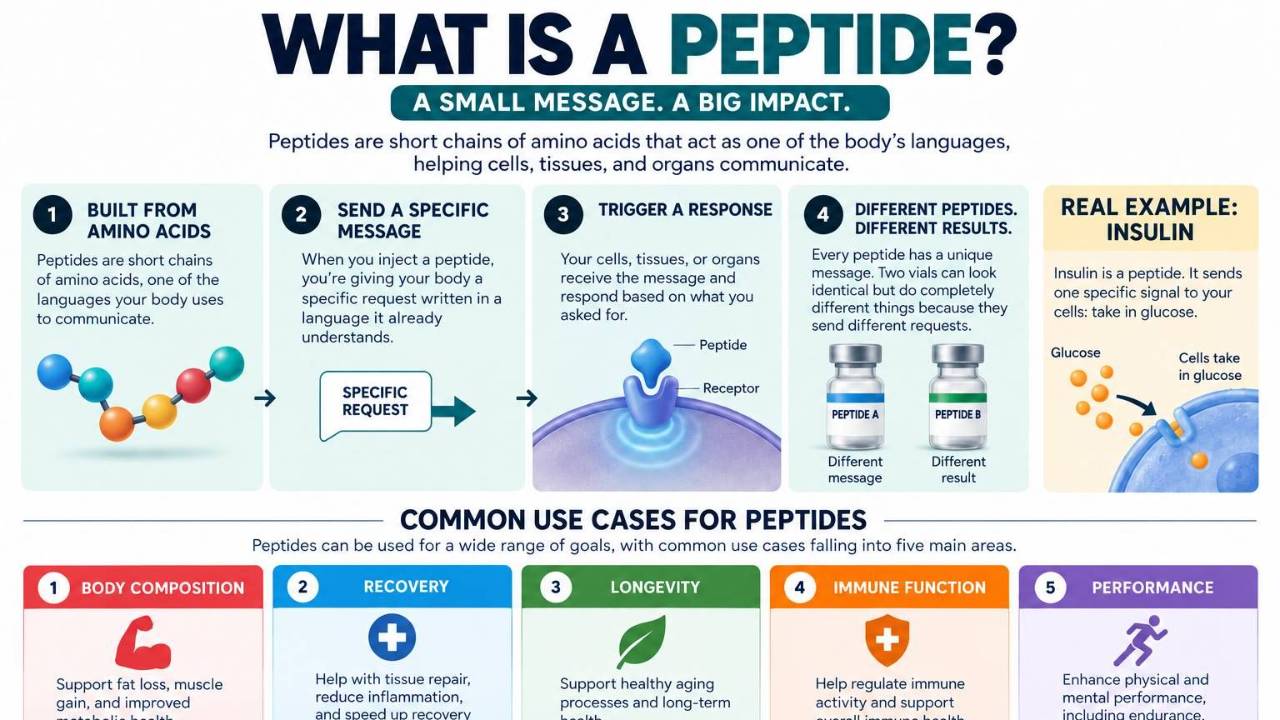
The High Performance Journal Written By Dan Go - September 8th, 2026
Peptides have become one of the most talked-about topics in health and fitness right now.
You've got people on one side treating them like the next great health elixir. On the other side, you've got people calling them an unregulated experiment being run on millions of people who don't know what they're signing up for.
You even have New York bodegas selling peptides on the street. The hype is insane.
bodegas are selling peptides now… this is the future pic.twitter.com/15cZ2kcL8d
— Linda (@Lin_DAO_) June 17, 2026
Personally, I've been "peptide curious" for a while now.
I currently don't take them, but I'm not opposed to testing out the right ones depending on my goals.
So, to understand this area properly, I sat down with my friend Dr. Abud Bakri.
He's a physician who works with these compounds clinically every day and was recently interviewed by Andrew Huberman on his podcast.
He's one of the rising voices in this space and someone I trust to give it to me straight.
So in today's newsletter, we're going to talk about:
- What are peptides
- What people use them for
- Whether or not they're safe
And at the end, we'll answer the one question people should be asking before taking these (but aren't).
You ready? Let's go 🔥
DG's Note: This newsletter is not sponsored. I don't own a peptide clinic. I have zero affiliate codes. There is nothing for sale here. Depending on where this space goes, I may partner with one in the future. That aside, this is not a newsletter about whether or not you should take peptides. That's not my call. It's about understanding them well enough to make that decision properly with the right guidance.
What Is A Peptide?
Abud explained it in a way that made it click for me. He said amino acids are one of the languages the body uses to communicate between cells, inside cells, and between organs.
So when you inject a peptide, you're handing your body a specific request written in a language it already understands. What you get back depends entirely on what you asked for.
An example of a peptide is insulin. It sends one specific signal to your cells to take in glucose. Every other peptide works the same way, just with a different request.
As Dr. Bakri puts it,
"Talking about peptides as a single category is like saying you take supplements. Creatine and omega-3 are so different that putting them in the same sentence doesn't communicate anything useful."
The common use cases break into 5 areas:
- Body composition
- Recovery
- Longevity
- Immune function
- Performance
At the time of writing this, I'm 46. I surf, I train, healthy bloodwork and body fat, while my body is feeling pretty good. I don't feel the need for peptides right now.
But if something happened and I got injured and wanted to heal quickly, that's where I'd open up the conversation around recovery.
Which leads to the question everyone wants answered.
Are Peptides Safe?
There is a common belief, especially from people who are pro-peptide, that because peptides naturally occur in the body, they're inherently safe.
Abud, who administers these compounds to actual patients, says the complete opposite. As he put it to me:
"They're just like any other drug. They have side effect profiles, they have risk benefits. Just because they exist naturally doesn't mean injecting 10x the dose makes it by default safe."
A peptide like Ozempic is not a naturally occurring compound. It was designed in a lab. And even the peptides that do occur naturally are being administered at levels the body would never produce on its own.
The honest answer to "are peptides safe?" is that it's an incomplete question. Safe compared to what? For whom? At what dose? Over what period?
3 areas came up in our conversation that matter the most:
Area 1: Who should be cautious. A lot of the peptide advice online comes from people who are young, healthy, and don't take anything else. Abud has seen patients on multiple diabetic medications who were told to take retatrutide based on an online recommendation. They ended up with dangerously low blood sugar and were passing out. These are medicines that should be done under the supervision of a professional.
Area 2: The evidence gap. GLP-1 compounds have strong human data, and they're FDA-approved.
BPC-157 is a different story. The animal research is genuinely strong, but the human data came from very small trials that never got past phase two. One study had only two participants.
What made the conversation interesting was when Abud took off his doctor hat.
"As a bodybuilder, BPC-157, I've had amazing results with it personally. I tore my triceps, I've had ACL surgery from a jiu-jitsu injury, and the rate of recovery has been fantastic. I have this dilemma inside of me because I know it works personally for me. I don't have the research data to tell a patient I can recommend this. As a doctor, I'm going to be very skeptical. And that's a good tension to have."
That gray area between personal results and clinical data is exactly where this compound lives right now.
Area 3: Combinations. This is the part nobody's talking about. I asked Abud what the question is that nobody's asking about peptides. His answer surprised me.
"What are the 2nd and 3rd order interactions between everything people are doing? There's already such little data on one or two of these peptides. Imagine taking them all at once. You're taking GLP-1s. You're taking a growth hormone secretagogue, so you're increasing the growth rate of cells. Then you're taking BPC-157 and TB-500, which may have some cancer risks. One at a time might not be a problem. Stack them all together, and now what's happening? No one's even equipped to answer that question."
The day before our interview, I came across someone documenting 8 compounds they were taking at the same time. How do you even know what's working? The honest answer is you can't.
The Question That Actually Matters
After everything we covered, the natural question is which peptide to take.
But Abud revealed the question we should be asking:
"Whenever someone asks me about peptides, I ask them: what peptide and what goal? We shouldn't be thinking 'I want to take peptides.' Deconstruct what the goal is. What is the state or trait you're looking for in your physiology? And then let me help you get there. That might be a supplement, a medication, a peptide, a different hormone, a lifestyle intervention. Doing peptides for the sake of peptides is the trendy thing."
This reminds me of a time I was talking to a friend who was taking 4 peptides at the same time.
I asked him what he was trying to accomplish, and he looked at me like I was on crazy pills. He didn't have a goal. He wasn't measuring anything.
He saw the trend, saw peptides first, and then went looking for a reason to take them.
The Goal Determines The Tool. Not The Other Way Around.
Abud walks his patients through 4 steps that are worth understanding even if you never take any of these compounds.
Step 1: The foundation comes first
As Abud explained:
"If somebody's not sleeping well, not eating right, not exercising, and they think peptides are magically going to make them perform better, the peptide is the wrong discussion. Let's get 80, 90 percent of the benefits from there, and then we'll talk about the exogenous compounds."
He went further on this:
"It's the person that's already doing the exercise who gets the GLP-1 and has better results, on a lower dose, with less side effect risk. The person that doesn't do anything right takes it and says, 'this is fake, it doesn't work.'"
Step 2: Start with one compound
Not 8. Not 9. Abud sees people loading up because the affiliates online get the stuff for free. His approach is one at a time, observe the effect, then add another if needed.
Step 3: Establish a baseline
Without one, there's no way to evaluate whether something worked. Labs like A1C, fasting insulin, triglycerides, lipid panel, IGF-1. But also things that don't show up in blood work: sleep quality, mood, digestion, libido. The observable things are what most people skip.
Step 4: Have an exit plan
"The way we think about GLP-1s is like training wheels," Abud told me.
"We give you training wheels on your bike, you learn how to bike better, and then once you're ready we take them off, as long as you keep biking. But some people don't do that. They say, 'I've got 20 pounds to lose, give me the drug, and I'm off.' That's not going to be good."
What Do We Do From Here?
These compounds are real, and some of them are genuinely useful. They're neither miraculous nor fraudulent.
What stuck with me was this:
The people who get the most from these compounds are the ones who already have the foundation in place. The people using them to bypass that foundation tend to end up where they started.
We have a few clients currently taking peptides, and I find that the right ones give us a window of opportunity to make the changes needed to get our clients back to a healthy baseline.
But these still need to be treated as if they're medications and done with the help of a doctor.
I will be releasing the full conversation with Abud on my YouTube channel soon. We covered considerably more ground than I could fit here.
Also, thank you to my friend and special guest for the assist on this newsletter. I recommend following Dr. Abud Bakri on X, where he's most active, or checking out his website here.
In the meantime, where do you stand on peptides? Hit reply and let me know.
Onward and upward. 🚀
- Dan
When you're ready, here are 2 ways I can help:
1. The Lean Body 90 System: When you’re ready to get in great shape, Lean Body 90 is the obvious choice. You can get in great shape and reach your fitness goals in just 90 minutes a week. Lose weight and build muscle even without hours in the gym or highly restrictive diets. Join 1000+ students here.
2. Are you an entrepreneur who wants to get lean, boost energy, and get in your best shape? Apply for private one-on-one coaching here.
Disclaimer: This email is provided for educational and informational purposes only and does not constitute providing medical advice or professional services. The information provided should not be used for diagnosing or treating a health problem or disease, and those seeking personal medical advice should consult with a licensed physician.